

In Los Angeles, one of the primary tools for reducing shelter overcrowding and preventing unplanned litters is the City’s spay-and-neuter voucher program.
At its core, the program is straightforward. It helps offset the cost of spaying or neutering pets by providing financial assistance directly to residents through vouchers–essentially coupons that Los Angeles City residents can apply for through the City, then take to a participating vet to reduce or fully cover the cost of a spay or neuter procedure.
Two Types of Vouchers
Within the City system, the voucher program operates through two primary forms of support: some people qualify for the surgery at no cost, and everyone else can get a discount.
The free spay-and-neuter certificate is available to residents who meet household low-income thresholds. For those who qualify, the procedure is fully covered. The City reimburses participating veterinarians at a set rate ($120 for cats and $195 for dogs), effectively removing cost as a barrier to care.
The discount voucher is available to all City residents, regardless of income. These vouchers reduce the cost of the procedure by a fixed amount ($30 for cats and $50 for dogs). Modest, but a real lever to make the service more accessible.
Both options rely on a network of participating veterinary providers who opt in to accept these vouchers, perform the procedures, and are either reimbursed or partially subsidized by the City.
What the Program Covers and What It Doesn’t
The program is designed specifically for owned pets–dogs, cats, and rabbits living in households of City residents. It does not extend to stray or feral animals, nor does it cover animals being handled by rescue organizations.
This distinction reflects the program’s intent: to reduce the number of animals entering the system by preventing unplanned breeding at the household level. Other programs and funding streams typically address stray populations.
Constraints on the System
While the structure of the program is relatively straightforward, its capacity is tightly constrained by funding, provider participation, and administrative limits.
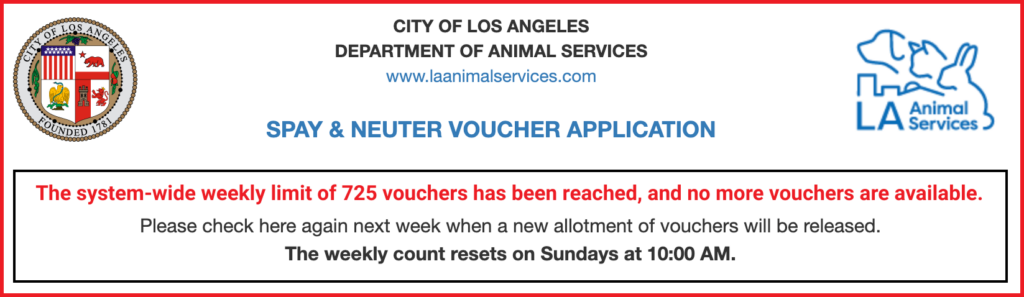
The City releases a fixed number of vouchers each week, currently capped at 725. Demand consistently exceeds that supply, with vouchers often claimed within hours of release. This creates a rationed system, where access depends not only on eligibility, but on timing and availability.
Recent policy changes have added another layer of complexity. In 2025, the City increased voucher reimbursement amounts for the first time in a decade, raising them to better reflect current veterinary costs. While this adjustment was necessary to make participation more viable for veterinarians and clinics, it was not accompanied by an increase in the program’s overall funding. As a result, each voucher is now worth more money, but the program’s budget can cover fewer total surgeries.
At the same time, the number of participating clinics has declined significantly. Since 2015, provider participation has dropped by roughly two-thirds, from 85 clinics to just 29. Reimbursement rates have historically lagged behind the cost of care, and while recent increases help bring them closer to reflecting the actual costs of these procedures, they have not yet rebuilt the provider network to prior levels.
Fewer veterinarians participating in the program means fewer available appointments, longer wait times, and gaps in coverage across the city. As a result, even residents who successfully obtain a voucher may struggle to use it before it expires, because they can’t find an available appointment within their six-month redemption window. In practice, this means someone can secure a voucher but still be unable to schedule a procedure in time. This challenge is particularly acute in lower-income areas, where access to veterinary services is already more constrained.
These dynamics compound. As demand for services has risen, up nearly 22% in recent years, capacity has contracted. The result is a widening gap between need and access. More animals remain unaltered, more litters are born, and more pressure is placed on an already strained system.
In practice, the program is not just limited by how many vouchers are issued, but by how many can realistically be used. Funding levels, reimbursement rates, provider participation, and appointment availability all work together to limit how many people the program can actually serve.
Why It Matters
Los Angeles City shelters take in tens of thousands of animals each year. Spay-and-neuter access is one of the most direct ways to influence the broader animal welfare system. When access is widespread and affordable, fewer animals enter shelters, populations stabilize, and public costs decrease. When access is constrained, those pressures move downstream–more litters are born, more animals end up on the street or in shelters, shelters get overcrowded, and the City spends more money caring for them.
The voucher program sits at that upstream point. It is not a visible part of the system in the way shelters are, but it plays a central role in determining how much strain the rest of the system absorbs.
In that sense, the program is less about individual procedures and more about system-wide prevention. Its effectiveness and its limitations shape outcomes across Los Angeles’ entire animal services landscape.